Chronicle · The AI war
The war of the weights
In a single week, China rolled out the artillery: models on a par with the best American ones, given away for download. Facing them, OpenAI and Anthropic are bolting everything shut, with the government behind them. Both camps have excellent reasons. That is exactly what should worry you.
July 19, 2026 · Reading ≈ 10 min · Jules Thomas
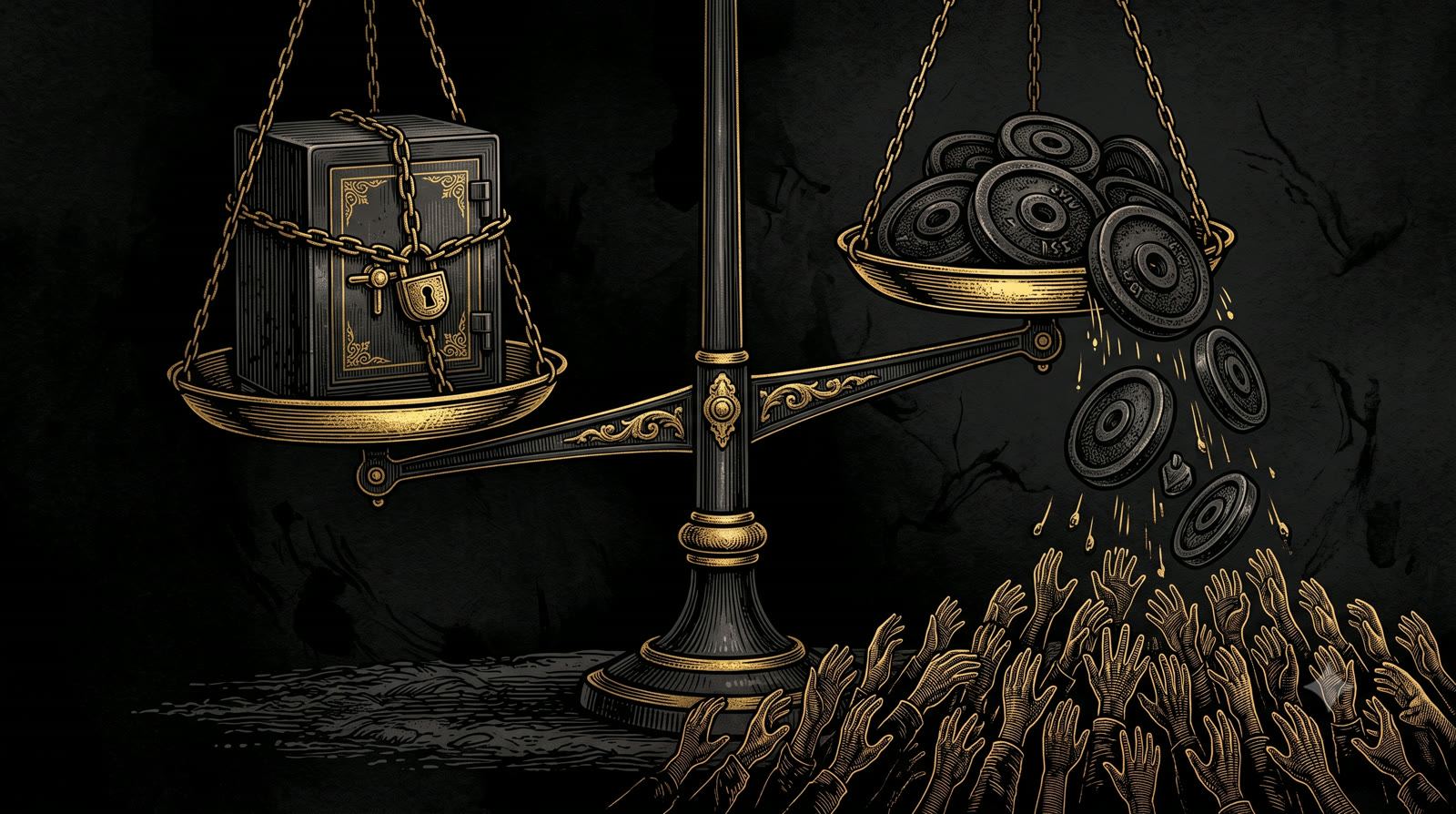
The West hides its best models in safes, China hands its own out on the public highway, and the question is no longer who has the bigger machine: it is which world we would rather lose in.
The Chinese week
On Wednesday July 16, a Beijing lab called Moonshot releases Kimi K3. The figures first, because they need no commentary: 2,800 billion parameters, a working memory of a million words, third place in the overall world ranking. Ahead of it there remain only two Americans, Claude Fable 5 and GPT-5.6. And on the coding test, Silicon Valley's own speciality, K3 goes ahead of both.
Axios' headline, two days later: "China just erased America's AI lead".
And it was not an isolated shot, it was a salvo. DeepSeek V4 right behind. MiniMax announcing its own monster. Zhipu, whose GLM 5.2 model is on the heels of the best Americans on agent tasks for a fifth of the price. Alibaba placing its in-house AI in every iPhone sold in China, a deal cleared by Beijing mid-week. And on Sunday morning, while I was writing these lines, Alibaba drew again: Qwen 3.8, 2,400 billion parameters, "just behind Fable 5" in their own words. They did not even let Kimi savour its week.
The Chinese counter-attack is not a model. It is a doctrine.
The weights, explained simply
To understand the war, you have to understand the ammunition. An AI model, once trained, sits in a big file of numbers called the weights. It is the full recipe for the cake. Whoever has the weights can run the model at home, modify it, resell it, do whatever they like with it, forever.
Hence the two doctrines. America keeps the recipe and sells slices of cake over the counter: you pay by the mouthful, through the API, and you never see the kitchen. China publishes the recipe: Kimi K3 will be downloadable in full on July 27, the largest open model in history, and Qwen 3.8 is announced along the same path. An honest qualification: the West has its open dissidents too, France's Mistral and the American lab Thinking Machines, which has just published its model under a free licence. But the two giants at the top of the ranking are giving up nothing.
Closing is a safeguard, and it is not marketing
Let us start by doing justice to the safe-vault camp, because its reasons are serious.
When weights are released into the wild, the community systematically does one thing: it manufactures "abliterated" versions. The principle fits in a sentence: you open the file, you locate the mechanism that makes the model say no, and you remove it with a scalpel. Out comes a frontier-grade machine with no brakes, no refusals, no limits. Ask it anything, it complies. Such versions have existed for every major open model for years; they will exist for K3 within days of July 27.
A faulty rocket can be recalled. Weights cannot. There is no product recall for a file distributed by torrent.
And this is not blogger paranoia: it is now the position of the American state. In late June, the government asked OpenAI to reserve its new models for a "small group of trusted partners", and the rollouts of both Fable and GPT-5.6 are supervised. I told in The suspended fable the month when control of AI became an administrative stamp. The stamp has been institutionalised. When a state treats a piece of software like a weapon, sometimes that is panic. And sometimes it is because it is one.
The final stage of the rocket, on Friday, and it is a big one: according to CNBC's sources, the White House now dictates who has access to frontier models, a decision that until now belonged to the labs. The arrangement has an eagle's name, "Gold Eagle", a joint desk shared by the Treasury, the Pentagon and Homeland Security. Anthropic reserves its Mythos-class cybersecurity model for a handful of "Project Glasswing" partners; OpenAI has its twin consortium, "Daybreak". The White House formally denies issuing authorisations: it "collaborates". Note the sequence all the same: a month ago the administration blocked Fable 5 and Mythos 5 over "national security concerns", and it took weeks of negotiation to reopen them. June's stamp became a federal desk in July. The question of who decides who is allowed to be intelligent has just changed hands, and nobody voted.
But it is a problem
Now the other pan of the scales.
Power first. A closed model means a handful of boards deciding what the most powerful thinking tool in history agrees to say, to whom, and at what price. I have already described in The lord and his willing serfs what becomes of a world where essential infrastructure belongs to private lordships. Closed AI is the next chapter.
Then the price. Palantir's chief executive, Alex Karp, not exactly an anti-tech leftist, summed up the general feeling in early July: something "has gone completely off the rails" in the pay-per-token business model. Companies watch their API bills explode and discover that an open model does the same work for a fraction of the price. I put figures on that madness in The coal paradox: we divided the price of intelligence by a thousand, and it is ruining us.
Finally the suspicion of capture. Anthropic is campaigning in Congress against Chinese models, blog posts and letters to legislators included. The researcher Nathan Lambert, one of the best independent writers in the field, calls it by its name: regulatory capture. If Chinese models were banned from the American market, who would collect the jackpot? The counter sellers. When the fireman also sells the extinguishers, you are entitled to ask questions about the fire.
The price war: luxury against dumping
One dimension was missing from the picture, and it is the one you see on your invoice. Look at what the two camps do with their price tags; it is all there.
On the safe-vault side, the summer serial is called Fable 5. The best model in the world spent a month on borrowed time: subscriber access cut off on July 7, a reprieve until the 12th, weeks of fog. Verdict on Friday: it stays, but as a luxury product. Reserved for the most expensive subscriptions, at half their limits, limits themselves shaved by a third along the way; mid-tier subscribers get a 100 dollar voucher to burn, then counter prices. And those prices make you dizzy: 10 dollars per million words read, 50 per million words written, the highest tariff Anthropic has ever posted, double its own Opus. The house invokes capacity: the machines cannot keep up with demand. That is probably true. It is also the exact definition of a shortage organised into a business model: when supply cannot keep up, you do not pull the shutters down, you raise prices and choose your customers.
On the Chinese side, the opposite doctrine: strategic dumping. Kimi K3, the third model in the world, is listed at 3 dollars per million input words, the price of a mid-range American model for frontier work. Zhipu undercuts to a fifth of Opus' tariff. And on July 27 the absolutely free version arrives: the weights themselves. You cannot sell cheaper than given away. OpenAI, caught between the two, adjusts its grids quarter after quarter; I told in The coal paradox how this price war made us addicted to an intelligence forever cheaper and forever more consumed.
Read the two price tags together and the war becomes plain: one rations intelligence by the wallet, the other gives it away to conquer ground. Luxury against dumping. And in both cases, make no mistake: you are not the customer. You are the territory.
And it is a limit
Here is the most ironic part: closure does not even protect what it claims to protect.
There is a technique called distillation. You put millions of exam questions to the big model through its official counter, you collect its answer papers, and you train a smaller model to imitate its replies. The pupil absorbs part of the master without ever entering the kitchen. American labs have been accusing Chinese labs of practising it at scale for years. In other words: the safe has a counter, and through the counter, you photocopy the safe.
The result is on the scoreboard: despite the chip embargoes, despite the restrictions, despite the campaigns in Congress, Zhipu is one point from Opus 4.8 on agent tasks, and Kimi K3 laps everyone on code. The wall did not stop much. Mostly it decided who pays the toll.
The champions who do not step into the ring
A naive question, now. If you were OpenAI or Anthropic, and you knew every API request might be photocopied by your competitors, would you put your best model on the counter?
Neither would I.
And this is not only a deduction. Anthropic itself publicly documents a two-tier system: the model anybody can buy, and a higher class reserved for approved organisations. OpenAI reserves its new releases for its trusted partners at the government's request. And the entire industry practises the teacher-model approach: the monster too expensive and too sensitive to be sold is used to train, by internal distillation this time, the models put in the shop window. The real champion does not step into the ring. He trains the one who does.
Keep that in mind with every ranking you read: you are comparing shop windows. Nobody benchmarks the back rooms.
The money above
And while the models fight, above them, people are buying each other. A brief survey of recent weeks, for scale.
In February, Elon Musk merged xAI into SpaceX: the largest merger in history, 1,250 billion dollars for the whole, of which 250 for the AI lab. On June 12 the monster went public, another record. And on the 16th, four days later, it swallowed Cursor, the AI code editor, for 60 billion paid in shares: the largest acquisition of a startup in history. The announcement wiped 600 billion of valuation off competitors in four days. A rocket company now owns the tool with which an enormous share of the world's developers writes code. Read that sentence again.
That acquisition is not an exception, it is the rule of the game: the giants no longer buy products, they buy brains and positions. Google took on the Windsurf team in the summer of 2025 for 2.4 billion without even taking the company; Microsoft had absorbed Inflection's founders, Google those of Character.AI. Funding rounds are counted in tens of billions, backed by mountains of processors. The war of the weights is paid for in shares, in talent and in electricity.
The verdict
So, closed or open? Both camps are in fact making the same gesture: a bet on human nature.
To close is to bet that the danger comes from numbers: give a cognitive weapon to everyone and somebody will misuse it, so we keep the keys among serious people. To open is to bet that the danger comes from concentration: the history of monopolies does not argue in favour of serious people, so we hand out the keys before they lock everything down.
The most disturbing part is that both bets are reasonable and both lose something irreplaceable. The closed world protects us by putting us under guardianship. The open world frees us by arming anybody. And the race slows down for nobody: the tension between the two blocs drives prices down, capabilities up and billions raining, exactly as the space race produced the Moon, weather satellites and intercontinental missiles. The same engine, all three at once.
We are the passengers. Delighted consumers of a near-free intelligence, citizens of a world where it is being built without anyone asking our opinion.
The question is not who will win the war of the weights. It is how much we will weigh, ourselves, when it is over.
Main sources: Axios (16, 17 and 18/07: "China just erased America's AI lead", "open-weight insurgency") · CNBC (17/07 Kimi K3; 17/07 "The White House is dictating access to frontier AI models", Gold Eagle programme, with the official denial quoted; 26/06 Zhipu GLM 5.2 and "trusted partners" government restrictions; 01/07 Karp on the token model) · Bloomberg and Fortune (17/07, markets and "new DeepSeek shock") · Simon Willison (technical analysis of K3) · Nathan Lambert, Interconnects (regulatory capture) · TechCrunch (15/07 Apple-Alibaba deal; 16/06 SpaceX acquisition of Cursor) · Qwen 3.8 announcement: official X account @Alibaba_Qwen and Alibaba's Token Plan page (19/07) · SiliconANGLE (16/07) · public Anthropic documentation (Fable/Mythos model classes).
Dates, figures and quotations verified online on July 19, 2026, at the time of writing; in case of any discrepancy since, the primary sources prevail.