Investigation · Power & technology
The Lord and His Willing Serfs
An arm thrust out, twice, on a stage in Washington. The old question rises at once: is Musk a fascist? The honest answer is no. And it is that "no" that should worry us. For behind the false charge of nazism grows a power of a new kind, one that is not won by arms but by infrastructures, and that does not impose itself. It lets itself be desired.
Reading ≈ 24 min · Jules Thomas
Introduction. The gesture and the symptom
On January 20, 2025, at the Capital One Arena in Washington, on the sidelines of Donald Trump's second inauguration, Elon Musk strikes his chest and then thrusts his right arm forward, palm toward the ground. He repeats the gesture toward the crowd, calling out: "My heart goes out to you."1 Within minutes, the image fractures the public sphere. The historian of fascism Ruth Ben-Ghiat sees in it "a Nazi salute, and a very belligerent one."2 Supremacist groups cheer it on their channels.3 Conversely, the Anti-Defamation League, hardly expected as Musk's defender, calls for restraint: "an awkward gesture in a moment of enthusiasm, not a Nazi salute."4 The man himself turns the accusation into mockery: "the 'everyone is Hitler' attack is so tired."5
One may hold the ambiguity to be calculated. In the following days, Musk multiplies puns on the names of Nazi dignitaries, then intervenes by video at the AfD campaign launch in Halle to invite Germany to move beyond "the guilt of the past."6 But the essential is not there. The gesture is a symptom, and the diagnosis it calls for is not the one we think.
Historical fascism was a hyper-statism: "Everything within the State, nothing outside the State, nothing against the State," in Mussolini's formula. It subordinated the productive apparatus to public power. Now Musk's project does the reverse: he does not seek to seize the state in order to militarise it, but to weaken it, so that his private platforms become the new structures of sovereignty. To call him a "nazi" is to commit a comfortable anachronism: we file an unprecedented threat in a twentieth-century box, and spare ourselves the trouble of thinking the twenty-first. I announce the thesis before the demonstration, at my own risk: Musk is not the return of a totalitarian past. He is the outpost of a new order, a techno-feudalism, of which we, you and I, are the willing serfs.
1. The Chapoutot grid, and why it does not suffice
To describe the inner workings of the Musk empire, a first grid imposes itself, a seductive one: that of the historian Johann Chapoutot. In Libres d’obeir. Le management, du nazisme a aujourd’hui (Free to Obey: Management, from Nazism to Today) (Gallimard, 2020), he shows that the Third Reich was not a rigid, pyramidal bureaucracy, but a polycracy of agencies set in competition for pure performance.7 He follows the trajectory of Reinhard Hohn, an SS jurist never troubled after 1945, who at the Bad Harzburg academy became the trainer of hundreds of thousands of managers of the West German "economic miracle," around one principle: the employee is "free to obey," autonomous in execution, never in the aim.8
The parallel with Musk's "hardcore" management seems, at first glance, striking: outsized work weeks, open contempt for unions, brutal waves of layoffs after the Twitter takeover, permanent competition among teams in the service of a transcendent "Mission," Mars or "free speech," which justifies the exhaustion of the human reduced to an interchangeable input.9
But honesty demands it: before brandishing the analogy, we must disarm it ourselves. Chapoutot's thesis is seriously contested by historians. Thibault Le Texier (CNRS), in the Revue d’histoire moderne et contemporaine, charges it with a "reductio ad Hitlerum": "the first part describes a scarcely managerial Nazism, the second a scarcely Nazi management."10 The political scientist Marcel Guenoun recalls that contemporary public management stems from the Anglo-Saxon theories of transaction and agency costs, not from Hohn's Germany.11 The genealogy of hardcore management is first of all Taylorism and Fordism, which Nazism borrowed, not invented.
This contestation does not weaken our argument: it founds it. If we must distinguish the facts (Hohn, Bad Harzburg, the techniques of delegation) from the causal continuity (Nazism as the matrix of today's management), then the reverse gesture is just as necessary: to stop looking in Musk for the signature of Hitler. Musk's managerial style stems from a radicalisation of capitalist optimisation and of algorithmic governmentality, not from an inheritance of the Reich. The Nazi analogy, here, does not illuminate: it blinds.
2. From apartheid to pronatalism: the ideological matrix
To understand the man, one must pass through Pretoria, distinguishing there, again, the documented from the interpreted. Born on June 28, 1971 in Pretoria, he grows up in the South Africa of apartheid, within the white elite.12 His father, Errol, a Pretoria city councillor from 1972 to 1983 under the label of a liberal opposition party, will later make revisionist statements minimising the oppression of Black people.13 The story of a family fortune built on an emerald mine, often repeated, must be handled with caution: no document attests to ownership of that mine, the figures advanced come from Errol alone, and Elon denies it. What is established is a comfortable lifestyle, not the myth of a founding mine.14
One rough edge, here, thwarts the easy indictment: Musk leaves South Africa at seventeen, in part to escape compulsory military service under apartheid.15 The biography resists the prosecuting portrait, and so much the better: a thesis that survives its counter-examples is sturdier than one that avoids them.
One may argue, and this is a reading, not a proven psychological fact, that growing up in an explicitly supremacist society may have made the hierarchies of race and class banal to him. This substrate would have metamorphosed into a pronatalism tinged with eugenics peculiar to a fraction of the tech elite. The statements themselves are documented: in 2021, before the Wall Street Journal CEO Council, Musk declares that "if people don't have more children, civilisation is going to crumble";16 he makes demographic collapse a risk "much greater than global warming," a thesis demographers judge exaggerated, the UN projecting a world population growing until around 2100.17 Father of at least a dozen known children by several women, he resorts, avowedly, to assisted reproduction.18
This utilitarian vision of parenthood is lit by an intimate drama that must be reported from both sides, without ruling. In 2022, on reaching adulthood, his transgender eldest daughter Vivian Jenna Wilson obtains the legal change of her name and gender, and breaks with her father.19 Musk speaks publicly of a "son killed by the woke virus" and says he was "tricked" into consenting to a treatment.20 Vivian refutes it word for word: she describes an absent father who harassed her femininity from childhood.21 The investigation will not settle the intimate; it notes only that, in Musk's public rhetoric, a family rupture becomes the episode of a "cognitive war" against progressivism.
There remains the question of drugs, which must be treated with clinical exactness. Admitted fact: Musk himself acknowledges, in March 2024, taking ketamine on prescription against a depressive state, "a small dose every couple of weeks."22 Contested claim: the Wall Street Journal and then the New York Times alleged, on anonymous sources, a broader use (near-daily ketamine, LSD, ecstasy, mushrooms), which Musk vigorously disputes, going so far as to publish a negative test.23 To confuse the admitted and the alleged is the cardinal sin of the trade. I keep them apart.
3. Feudal anarcho-capitalism: above the nations
If the fascist analogy fails, it is because it mistakes the direction of the power. Musk's project is libertarian: to dismantle public regulation in order to erect private infrastructures into de facto sovereignties. Three levers make it visible.
First, information. The takeover of Twitter for 44 billion dollars, finalised in October 2022 (the platform is renamed "X" only in July 2023), gives him one of the main channels of global political communication.24 He uses it: reinstatement of banned accounts, personal involvement in the Trump campaign ("I'm not just MAGA, I'm Dark MAGA," Butler, October 2024),25 and more than 290 million dollars spent to elect Trump, which makes him the top donor of the cycle.26 His lottery of "a million dollars a day" offered to signatories of a petition in swing states survived a court injunction, his own lawyers acknowledging that the winners were not "drawn at random" but paid "spokespeople."27 As for a deliberate algorithmic rigging in his favour, one must stay cautious: an Australian working paper, not peer reviewed, notes an abnormal spike in his account's visibility around July 2024, but concludes in the conditional.28
Second, logistics. With SpaceX and the Starlink constellation, Musk holds an unprecedented grip on civilian and military satellite communications. The Ukrainian case illustrated it, but here again, the sensationalist version is false. The biographer Walter Isaacson had first written that Musk allegedly "cut off" Starlink near Crimea to defeat a Ukrainian attack in 2022; he retracted publicly: coverage had, in reality, never been activated in that zone (American sanctions), and Musk refused to authorise its extension, invoking the risk of escalation.29 The fact, deflated of its legend, remains dizzying: an unelected private actor holds the exclusive technical capacity to validate or block a military operation of a sovereign nation.
Third, the state itself. In January 2025, Musk takes the head of the Department of Government Efficiency (DOGE), a temporary body created by executive order and set to expire on July 4, 2026.30 During his passage, he formally leaves it on May 28, 2025, DOGE sends buyout offers to two million civil servants, gains access to the Treasury's payment systems, and lays off by mistake engineers of nuclear weapons safety, rehired urgently a few days later; a parliamentary commission calls its methods "catastrophic."30 The merger of private capital and public power is no longer a metaphor: it has had an org chart.
These levers, information, logistics, administration, to which are added xAI, Neuralink and a fortune whose trajectory says everything, sketch a figure two economists have named. The first person in history to pass 400 billion dollars in December 2024, Musk becomes, on June 12, 2026, thanks to the SpaceX stock market debut, the biggest in history, the first trillionaire humanity has ever known.31 Set the numbers side by side: 44 billion for the speech, 290 million for the election, a thousand billion on the counter. These are no longer prices. They are tolls. For Cedric Durand (Techno-feodalisme, La Decouverte, 2020) as for Yanis Varoufakis (Technofeudalism, 2023), we are witnessing a mutation: accumulation no longer rests on the production of commodities but on the capture of rents and intellectual monopolies.32 Durand speaks of a capital that "abandons production to concentrate on predation," and of the dependence of subjects on the "digital glebe."33 Varoufakis rules: "Capitalism is dead"; cloud capital has replaced capital, rent has replaced profit, and we have become cloud serfs, serfs of the cloud, producing data for free with every click.34
The thesis is not a dogma. The reference Marxist critique, Evgeny Morozov in the New Left Review, objects that none of this is "feudal": rent and dispossession are central features of capitalism itself, not an exit from it.35 The debate stays open; what matters here is the shift it registers, from the market toward dependence, from the citizen toward the captive user.
4. Algorithmic voluntary servitude
There remains the question the indictment of Musk always evades, because it implicates us: why do we accept it? A lord does not reign without serfs, and no one has forced us to serve him. It is here that we must summon the founding text, not out of scholarly vanity, but because it says the essential.
Around 1548, in the Discourse on Voluntary Servitude, Etienne de La Boetie poses the enigma that concerns us: how does one man dominate millions, when he has "but two eyes, but two hands, but one body"? His answer is implacable: the tyrant has no power but the power we lend him. "Resolve to serve no more, and you are at once free."36 Domination holds not by force, but by habit, by the entertainment that lulls, and by the chain of interests that ties the summit to those who profit from the system.
Transpose to 2026. Force has disappeared; comfort remains. This is the heart of what Shoshana Zuboff named surveillance capitalism: human experience is claimed as "free raw material," translated into behavioural data, turned into prediction products sold on behavioural futures markets.37 A clarification, against a widespread laziness: the formula "if it's free, you're the product" is not Zuboff's. Its modern form dates back to an online comment from 2010, with a precedent in a 1973 video work.38 To attribute correctly is the first discipline.
The mechanism of consent, for its part, is ancient. As early as 1971, Herbert Simon stated the law of the attention economy: "a wealth of information creates a poverty of attention."39 We, modern serfs, no longer pay in corvees: in attention and in data. And we consent to it because delegating one's judgement to the machine is more restful than judging for oneself. Two recent columns have caught this tipping point, without academic weight of proof, but as apt illustrations: Bernard Attali describes "the man who obeys the GPS," for whom following the algorithm "requires less effort than thinking";40 Lennie Stern speaks of an "infra-servitude" that imposes itself not through ideology but seeps into the comfort of services, reducing the citizen to a user.41 Which researchers such as Antoinette Rouvroy have theorised under the name of algorithmic governmentality: a government by profiles and recommendations, which bypasses deliberation by acting upstream of the choice.42
And "free" AI? It is the last bait held out to the serf, and the most revealing. For it is not free: it is subsidised, for the time it takes to capture usage. Sam Altman himself admits to losing money even on his paid subscriptions;43 OpenAI's operating losses are said to run into the tens of billions in 2025, with profitability not expected before the end of the decade.44 The "free" is held at arm's length by venture capital and the cloud credits of the hyperscalers, and it has a very real material cost, in electricity and water, that the opacity of closed models leaves us only to estimate.45 The serf who demands his free AI and hands over his data with gratitude (I include myself: I run several a day, and this site owns up to the traces) reproduces, on a planetary scale, the exact gesture La Boetie described: he funds, himself, the machine that will pilot him.
The same scheme pays the attention of those who cultivate it. The revenue sharing for X creators (launched in July 2023, paying only for impressions from paid subscribers) obeys a power law, an infinitesimal minority captures the bulk, the mass gets crumbs, which is only the monetised version of La Boetie's sovereign entertainment.46 We are paid to produce the engagement that holds us.
5. The devil's advocate, or the absence of a gulag
We must now give the opposing objection its full force, for it is the most serious, and it circulates a great deal: popularised on X by Brivael Le Pogam, it crossed ten million views the day Musk relayed it on his own account.54 Here it is, faithfully summarised. Rather than accuse, says the devil's advocate, read: two biographies, dozens of hours of interviews, and not the slightest trace of racism. What you find is an obsession with freedom. Musk freed Tesla's patents in 2014,48 opened the code of Grok,49 published the "Twitter Files,"50 switched Starlink back on for the Iranians cut off from the network and for Ukraine.51 And above all, run the thought experiment his accusers never run: imagine he were genuinely malevolent. This man owns a network of satellites that covers the planet, the most influential digital public square in the world, the first thousand-billion fortune in history. A truly totalitarian Musk would not tolerate for a second being called a nazi twenty-four hours a day on his own platform. He would ban, surveil, crush. Now the accounts that accuse him still tweet, every day, unhindered. The dystopia attributed to him refutes itself by the absence of the gulag.
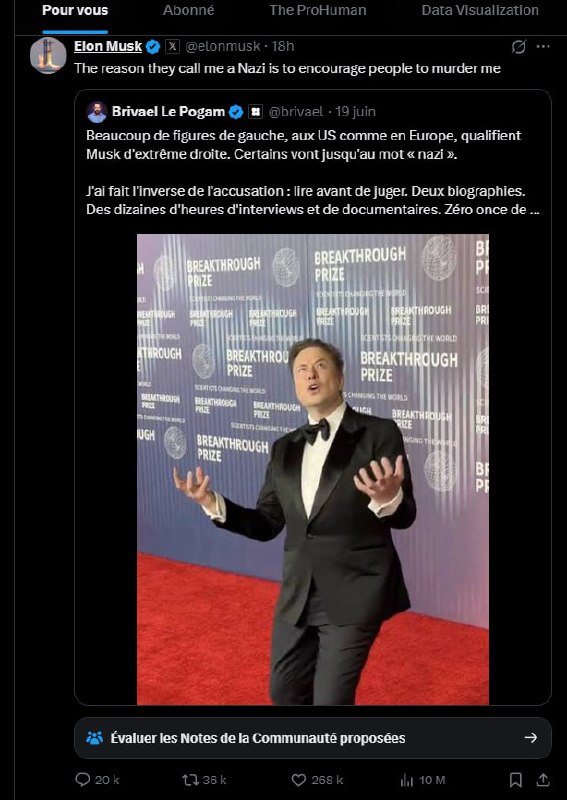
This objection is strong, and we must begin by conceding it, twice. On the facts first: the "freedom" record is real, and we do not contest it. On the logic next, and this is the essential: yes, an Orwellian tyrant would silence his critics, and Musk does not. The devil's advocate is therefore right on the decisive point, the same as ours: to look in Musk for a nazi, a Hitler, a Big Brother, is to mistake the era. The absence of a gulag proves the absence of the old tyranny.
Only the devil's advocate then commits the symmetrical error of his adversaries. They saw a nazi everywhere; he, having ruled out the nazi, concludes from it a hero of freedom. Both reason within the same rigged dilemma: either the gulag, or the saint. As if there did not exist, between the two, a third form of power. Now it is precisely the one this investigation names.
Three flaws, then. The first: "he lets his critics speak" measures power by the yardstick of the old world. Techno-feudal power does not ban, it sorts: it throttles reach, amplifies allies, shapes the feed. The scene offers an involuntary demonstration of it: the plea reproduced above, posted by an ordinary account, reached millions of eyes only the instant the lord deigned to share it. One has no need of a gulag when one owns the algorithm. The absence of the telescreen is not the absence of power, it is a more discreet and more profound form of it. Complete irony: in looking for Orwell to acquit him, the devil's advocate falls into the very trap he denounced in the accuser.
The second: "he lets us speak" is a grace, not a right. The Starlink-Ukraine episode showed it, he pulls the lever when it suits him. A freedom that depends on the lord's goodwill is the very definition of the feudal bond, not of freedom. The medieval serf could speak too, as long as it did not worry the castle.
The third: the freedom claimed is selective. The same platform has complied with states' censorship requests (Turkey, India), has suspended journalists who tracked its owner's private jet, has throttled terms and accounts that bothered him.52 "Obsession with freedom" is a narrative; "freedom for the speech that suits me, a lever against the speech that troubles me" is its exact version.
There remains the devil's advocate's subtlest move, and the most instructive: the argument from Rene Girard. The accusation, he says, always describes the accuser; the one who screams "nazi" often dreams, in silence, of the power to ban and to silence. This is pure Girard, the scapegoat,53 and it is in part true: the hunt for the "nazi" is indeed a mimetic panic, a ritual that welds the pack by designating the heretic. But the weapon turns: "the accusation describes the accuser" is a wholly general argument, which disqualifies any critique as projection, and thereby becomes unanswerable, hence hollow. Let us keep Girard's flash, the "nazi" as scapegoat, and refuse his reassuring conclusion. For to designate the scapegoat (the "nazi") and to acquit the lord are two twin ways of avoiding the only question that binds: not "is the lord good?", but "why should anyone, even a saint, hold these levers without accounting to us for them?" The feudal question is not moral. It is structural.
Conclusion. Stop looking for Hitler
So, Musk: hero, nazi, or Omni-messiah? The question, put this way, hesitates between two traps and misses the true face. Neither the monster we exorcise, nor the hero we idolise: an Omni-messiah, the all-powerful saviour who, believing himself master of the codes of reality, decides alone what he will share of it with us. It is this new figure, and not the ghost of Hitler, that we must learn to look at.
To look for Hitler or Mussolini in Musk's provocations is to reassure oneself on the cheap: to designate a familiar monster so as not to see the new apparatus. The danger of the twenty-first century is not a state totalitarianism, vertical and military; it is the voluntary and gradual abdication of democratic sovereignties before the infrastructures of dependence, and before the arbitrariness of their private owners.
This order is not invincible, however, and honesty commands us to say so. Durand himself sees in it a "shoddy Leviathan": a narrow social base, stock valuations suspended on fragile expectations, the competition of the Asian giants, a rising popular hostility even in the ranks that carried Musk to power.47 The lord of the cloud is powerful; he is not eternal.
Above all, his strength is, like that of all La Boetie's tyrants, our own, turned against us. Starlink goes out only because we have unlearned how to find our way; X governs opinion only because we have delegated our attention to it; AI captures our lives only because we hand it, for free, the means to model us. The consequence is clear, and has nothing of a metaphor: the struggle for freedoms passes first not through the denunciation of the lord, but through the rearmament of the intelligence of his serfs, and through the return of the indispensable technical tools to the control of the institutions of the common. "Resolve to serve no more." The rest will follow.
The real question is not whether the lord is good. It is why we are serfs.
Confession
One last thing, more personal, that I owe the reader.
This article cost me. Or rather: I struggled to write it, because at the start, I was a fan. His very vulgarity delighted me, his rockets made me dream. I knew him to be imperfect, of course: a genius, but a foolish genius, as they say, brilliant and terribly ordinary at once, closer to the man in the street than he believes. I even taught his mindset, back when I gave talks. I had read him, listened to him in interviews, and I found nothing disturbing in it.
Then I watched him slip. Piece by piece, in the manner of a Kanye West, something came undone. I questioned myself, and I felt, little by little, ill at ease. The question that haunts me is not even that of the accusation. It is this one: what if his excess, his very madness, were tolerated by fate only because he brings, genuinely, progress? Are we before one of those exceptional men to whom history forgives everything, because they make it advance?
And I must confess something else, less flattering to me. If the post I cite above irritates me, it is also because, in flattering the powerful as he does, its author, for his part, gains in visibility and in money; he even got himself relayed by Musk in person, the rascal. The courtier of old has not disappeared: he prospers, and still draws his cut by flattery. Meanwhile, I, what am I? An obscure techno-priest, angry and a little anxious.
History will judge Musk. But at bottom, I still hope. I hope he is only going through a bad patch, and that one day, after an awakening, he will become what he should always have been: the champion of freedom, and even of that share of compassion he fights today under the name of wokeism. The one who, convinced that we live in a video game, would finally decide to give us all the GTA cheat code.
Notes & sources
- The gesture of January 20, 2025, repeated. The Guardian, Jan. 20, 2025 ; JTA, Jan. 20, 2025. ↩
- Ruth Ben-Ghiat (NYU). The Washington Post, Jan. 21, 2025. Attributed interpretation. ↩
- Uptake by supremacist groups. Associated Press, Jan. 21, 2025. ↩
- Position of the Anti-Defamation League (verified quotation). The Hill ; The Times of Israel. A position criticised even within the Jewish world: The Forward. ↩
- Musk's response, Jan. 21, 2025. The Hill. ↩
- Nazi puns (Jan. 23, 2025): NPR ; Axios. Intervention at the AfD (Halle, Jan. 25, 2025): OPB / Associated Press. ↩
- Johann Chapoutot, Libres d’obeir, Gallimard, 2020. LSE Review of Books review. ↩
- On Hohn and Bad Harzburg (uncontested facts). En attendant Nadeau. The "free to obey" formula paraphrased from the book. ↩
- Twitter takeover ($44B) and mass layoffs: Britannica Money. The "hardcore" characterisation is presented as a reading. ↩
- Thibault Le Texier, "La Reductio ad Hitlerum de Johann Chapoutot," RHMC 67-3, 2020. Cairn ; full text. ↩
- Marcel Guenoun, Politiques et management public 37-2, 2020. Cairn. ↩
- Born June 28, 1971 in Pretoria. Britannica ; EBSCO. ↩
- Errol Musk, city councillor (1972-1983); revisionist statements. Wikipedia, "Errol Musk". ↩
- Emerald mine: contested story, undocumented ownership, denial by Elon Musk. Snopes ; InsideHook. ↩
- Departure at 17, in part to avoid military service. EBSCO ; Britannica. ↩
- WSJ CEO Council, Dec. 7, 2021. CNBC. ↩
- "Population collapse" (tweet, Aug. 2022); thesis contested by demographers. CNN. ↩
- "At least a dozen known children"; use of assisted reproduction. Parade ; TODAY. The exact total is not sourceable at agency level. ↩
- Vivian Jenna Wilson: legal change and rupture (2022). Wikipedia ; Global News. ↩
- Musk's statements (Jordan Peterson interview, July 2024). The Washington Post. ↩
- Vivian Wilson's response. NBC News ; El Pais (English). ↩
- Prescription ketamine acknowledged by Musk (Don Lemon interview, March 18, 2024). CNN Business ; Fortune. ↩
- Allegations of broader use (WSJ Jan. 2024; NYT May 2025), contested by Musk (negative test published). Bloomberg ; The Hill. Anonymous sources, always denied. ↩
- Takeover ($44B) finalised Oct. 27, 2022; renamed "X" in July 2023. Axios ; The Washington Post. ↩
- "Dark MAGA," Butler (PA), Oct. 5, 2024. Euronews. ↩
- More than $290M (FEC, Feb. 2025), including ~$239M via America PAC. CNN Politics ; NBC News. ↩
- "$1M/day" lottery; injunction denied (Judge Foglietta, Nov. 4, 2024); lawyers' admission. BBC News ; ABC News. ↩
- QUT working paper (Graham & Andrejevic), not peer reviewed. The Register. Conclusion in the conditional, not a proven rigging. ↩
- Isaacson's initial version then retraction: coverage never activated near Crimea, refusal to extend. The Guardian ; Fortune ; Snopes. ↩
- DOGE: created by executive order Jan. 20, 2025, expiration set for July 4, 2026, Musk's formal departure May 28, 2025, methods judged "catastrophic" by a commission. Wikipedia ; Britannica ; House Oversight (PDF). ↩
- First to pass $400B (Bloomberg, Dec. 11, 2024): CNN Business. SpaceX stock market debut on June 12, 2026, the biggest in history (~$75B raised, valuation >$2,000B), Musk becoming the first trillionaire: NPR, June 12, 2026 ; CNN Business. ↩
- Cedric Durand, Techno-feodalisme, La Decouverte/Zones, 2020 (Eng. trans. Verso, 2024); Yanis Varoufakis, Technofeudalism, The Bodley Head, 2023. La Decouverte ; Penguin UK. ↩
- Durand's thesis (rent, predation, "digital glebe"). La Vie des idees. Quotations to reconfirm page by page. ↩
- Varoufakis: "Capitalism is dead"; cloud capital / cloud rent / cloud serfs. Penguin UK ; The Sanders Institute. ↩
- Evgeny Morozov, "Critique of Techno-Feudal Reason," New Left Review 133/134, 2022. NLR ; Jacobin. ↩
- Etienne de La Boetie, Discourse on Voluntary Servitude (~1548). Wikisource, 1922 ed.. ↩
- Shoshana Zuboff, The Age of Surveillance Capitalism, PublicAffairs, 2019. PublicAffairs. The definition itself is debated. ↩
- Genealogy of "if it's free, you're the product": Andrew Lewis (MetaFilter, 2010), precedent Serra & Schoolman (1973); not attributable to Zuboff. Quote Investigator. ↩
- Herbert A. Simon, "Designing Organizations for an Information-Rich World" (1971). Oxford Reference. ↩
- Bernard Attali, "L'homme qui obeit au GPS," La Regle du Jeu, June 11, 2026. laregledujeu.org. Opinion essay, cited as illustration. ↩
- Lennie Stern, "Technofascisme: quand la peur du totalitarisme empeche de voir le pouvoir des infrastructures" ("infra-servitude"), Fondation Jean-Jaures. jean-jaures.org. Think-tank note, illustration. ↩
- Antoinette Rouvroy & Thomas Berns, "Gouvernementalite algorithmique et perspectives d'emancipation," Reseaux no. 177, 2013. Cairn. ↩
- Sam Altman acknowledges losing money on paid subscriptions (X, Jan. 2025). IT Pro. ↩
- OpenAI losses in the tens of billions in 2025 (reported by the Financial Times); profitability ~2029. Gizmodo. Primary source behind a paywall. ↩
- Energy and water cost of AI (orders of magnitude). MIT Technology Review ; "Making AI Less Thirsty," arXiv. ↩
- Revenue sharing for X creators (July 2023, Premium impressions); power-law distribution. TechCrunch. The mechanism is factual; the power law rests on sector sources. ↩
- Cedric Durand, "Le techno-feodalisme est un Leviathan de pacotille." Contretemps. ↩
- Tesla, "All Our Patent Are Belong To You," company blog, June 12, 2014 (patent release). tesla.com. ↩
- xAI publishes the weights of Grok-1 as open source, March 2024. x.ai. ↩
- "Twitter Files," late 2022 (internal documents released via journalists). Wikipedia. ↩
- Starlink activated for Iranians during the 2022 protests (sanctions exemption requested). Reuters, Sept. 23, 2022. ↩
- Censorship requests honoured (Turkey before the May 2023 elections, India) and journalist suspensions (Dec. 2022). Reuters, May 13, 2023 ; BBC, Dec. 16, 2022. ↩
- Rene Girard, The Scapegoat (Grasset, 1982); Violence and the Sacred (1972): the victimary mechanism and mimetic desire. ↩
- Argument taken from Brivael Le Pogam (@brivael) on X, June 2026, relayed by Elon Musk's account ("The reason they call me a Nazi is to encourage people to murder me"), hence its massive spread. Screenshot reproduced above. ↩