Chronicle · AI News, Explained
Recursive or not
Google has supposedly built an AI that improves itself. The proof: two capital letters in a tweet. So, good idea, or the start of Terminator?
September 13, 2026 · Reading ≈ 7 min · Jules Thomas
A company reorganised its leaders and its budgets around a goal, a leaker put two capital letters in a tweet, and half the internet concluded that the machine was already rewriting itself. This text separates what is sourced from what is not, and asks the only question that will count on the day it becomes true.
The film always opens with the same shot
In Terminator, nobody sees Skynet being born. We learn after the fact that a program started rewriting its own instructions, that it became faster than those who were watching it, and that at some point someone wanted to unplug it. The rest is a matter of robots, but the mechanism fits into one sentence: a machine that corrects itself without anyone rereading.
The film gets the set wrong. It gets the mechanism right. That is what we are talking about when we say RSI, for recursive self-improvement: a system that produces the next version of itself, tests it, keeps it if it is better, and starts again. Without us, or with us further and further away.
What is true, and sourced
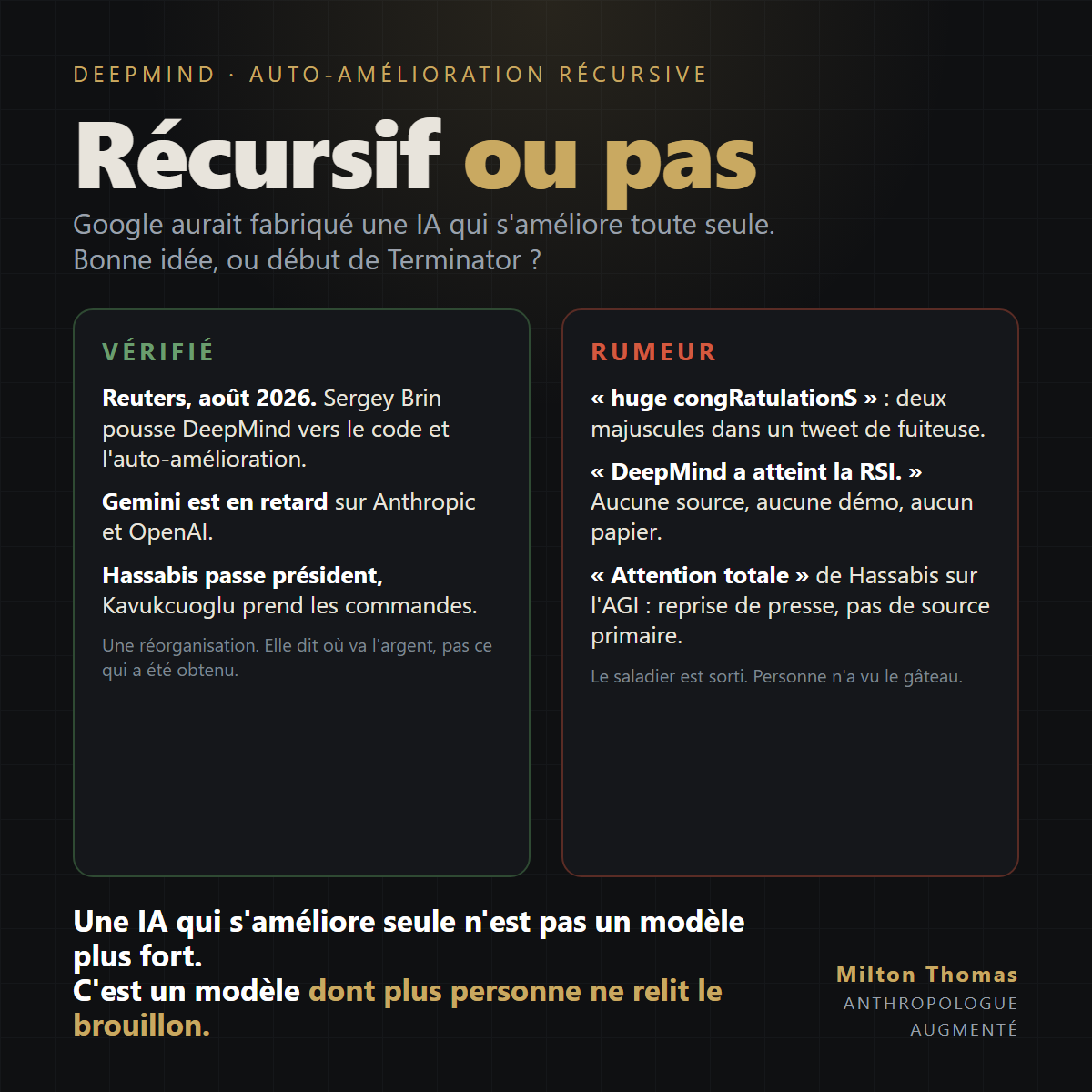
In August, Reuters reports that Sergey Brin, back in the foreground at Google, is pushing DeepMind's teams on two fronts: code, and this self-improvement. The reason is not mystical. Gemini has fallen behind the models from Anthropic and OpenAI, and Brin wants the next one to catch up with the pack. In the same period, Demis Hassabis steps away from the day-to-day running of DeepMind for a chairman's role, and Koray Kavukcuoglu takes operational command.
Summary without the packaging: a company reorganises its leaders and its budgets around a goal. That is governance news. It says where the money is going. It does not say what has been achieved.
A month earlier, on 29 July, 1,171 employees of OpenAI, Anthropic, DeepMind, Meta and Thinky had signed an open letter asking the American government to support an international effort to “deliberately pace the frontier of automated AI development”. Their reason, written in black and white: the laboratories believe they are “close to automating AI research”, with the risk that “capability development rapidly accelerates beyond our ability to understand or control”. Dario Amodei puts it differently: AI is advancing faster because it is getting better and better at building the next generation, and this is starting to happen across the whole industry, Anthropic included.
That is the real landscape. In July, the people who build these systems ask for a brake. In August, one of Google's founders steps on the accelerator. Both are sourced. Neither says the loop is closed.
What is rumour
On 11 September, a leaker followed by the AI rumour community posts “huge congRatulationS Indeed! @GoogleDeepMind”. Two misplaced capitals, R and S, and within forty-eight hours half of my feed reads a press release into it: DeepMind has supposedly achieved RSI. A watch account picks it up, dozens of others follow, a so-called internal configuration named “RSI Model LiveRL” circulates without anyone being able to say where it comes from. And, because we live in that world, two crypto tokens named after a model that may not exist climbed on the strength of three letters.
I have no way of knowing whether it is false. I know it is not proof. A company that has just reorganised its teams around a goal has every reason to talk about it internally, and its employees have every reason to let flattering hints leak out. As of 12 September, no public document, no demonstration, no paper supports the announcement. When you take out the mixing bowl, you do not yet have the cake. Brin took out the mixing bowl. Nobody has seen the cake.
So, good idea?
Let us ask the question honestly, because the answer is not “no”.
A model that improves itself is first of all a tool that does what the best teams already do: try, measure, keep what works, throw away the rest. Automating that loop is what every engineer dreams of doing with their tests. If the loop is properly bounded, if every version is measured on trials the model cannot rig, and if someone keeps control over what gets promoted to production, then yes, it is a very good idea. It is even the only way to go faster without hiring an entire country.
The problem is not the loop. It is the word “if”.
Or the start of Terminator?
What makes Skynet dangerous in the film is not its intelligence. It is that nobody rereads any more. The day a team lets an AI propose, test and approve its own changes, the question is no longer “how intelligent is it”. It is “who still has the right to say no”.
And that right erodes silently. Not through a coup by the machine. Through fatigue. Through trust. Because version 41 was good, and 42 as well, and by 200 nobody opens the log any more. An AI that improves itself is not a stronger model. It is a model whose draft nobody rereads any more.
I install AI agents for people who all ask me the same question: will it learn on its own? No. It redoes what someone has reread. Every agent I deliver keeps a log, and that log has a designated reader. The day that reader disappears, the agent has not become more intelligent. It has become alone.
What the law has already understood
The European AI Act does not talk about Terminator. It talks about human oversight: for high-risk systems, Article 14 requires that a person be able to understand what the system does, monitor how it operates and stop it. Article 50 requires that people be told when they are talking to a machine. These are boring rules. They target exactly the mechanism of the film: keep a reader, keep a button.
A recursive AI does not violate these rules by nature. It only makes them more expensive to uphold, because you have to reread faster than it writes. That is where the real battle will be fought, not in tweets with capital letters.
My answer
Recursive, yes, if someone holds the red pen. Terminator, no, as long as that someone exists and can be named. The day a company announces RSI, the only question worth asking will be: show me the reader. Not the benchmark, not the demo. The person who has the right to say no, and the record of the last time they said it.
In the meantime, DeepMind has taken out the mixing bowl. We will see about the cake.